


aifaculty.ai

How Does AI Assessment Improve Student Performance? The Ultimate Guide

How-Does-AI-Assessment-Improve-Student-Performance.
What-Role-Does-AI-Play-in-Digital-Transformation

Traditional classroom education is severely limited by a huge bottleneck. On average, teachers spend 10 to 15 hours a week just grading papers, which leaves teachers little time for real teaching. Besides, the learning momentum of students also fades away by the time they receive their graded papers, which is usually a couple of weeks later. Luckily, advanced AI assessment systems have started to disrupt the traditional pattern. By integrating smart data processing within the whole process of education, schools are able to identify learning deficiencies even before students receive low grades. 10-15 hours per week, on average, are lost by teachers just doing grading. Due to administrative tasks, about half of their time is being diverted from direct teaching, as per the findings of a study by McKinsey & Company. Such burdens have a knock-on effect of not only delaying teacher feedback but also slowing down students’ learning progress.

The Core Shifts: Traditional vs. AI-Driven Assessment

In the Traditional evaluation, the assessment mainly depends on single-moment metrics like midterm exams and finals. These final moments with very high stakes can cause extreme mental stress and fear of exams among students.


Shifting to a situation controlled by artificial intelligence reshapes this whole situation by transitioning from isolated examination cases to a constant flow of continuing assessment information.

Evaluation Metric

Traditional Testing

AI-Powered Evaluation

Feedback Turnaround

1 to 2 weeks

Real-time / Immediate

Evaluation Focus

Final correct answers

Misconception & logic analysis

Grading Overhead

Highly manual and repetitive

Automated first-pass grading

Learning Path

One-size-fits-all roadmap

Continuous, adaptive pathways

Data Scope

Single text-based format

Multimodal (Text, code, voice)


Recent statistics show that students studying in environments where an AI assessment in the education ecosystem is used perform attainment scores, particularly higher than those studying in traditional settings. In this article, we will discuss the ways this change occurs, the role of AI in student assessment, and how you can implement these workflows at your own institution.

How AI Assessment in Education Drives Mastery

The real change brought by AI tools in student assessment is not only faster grading; it is turning the teaching method from comparing students to helping them develop.

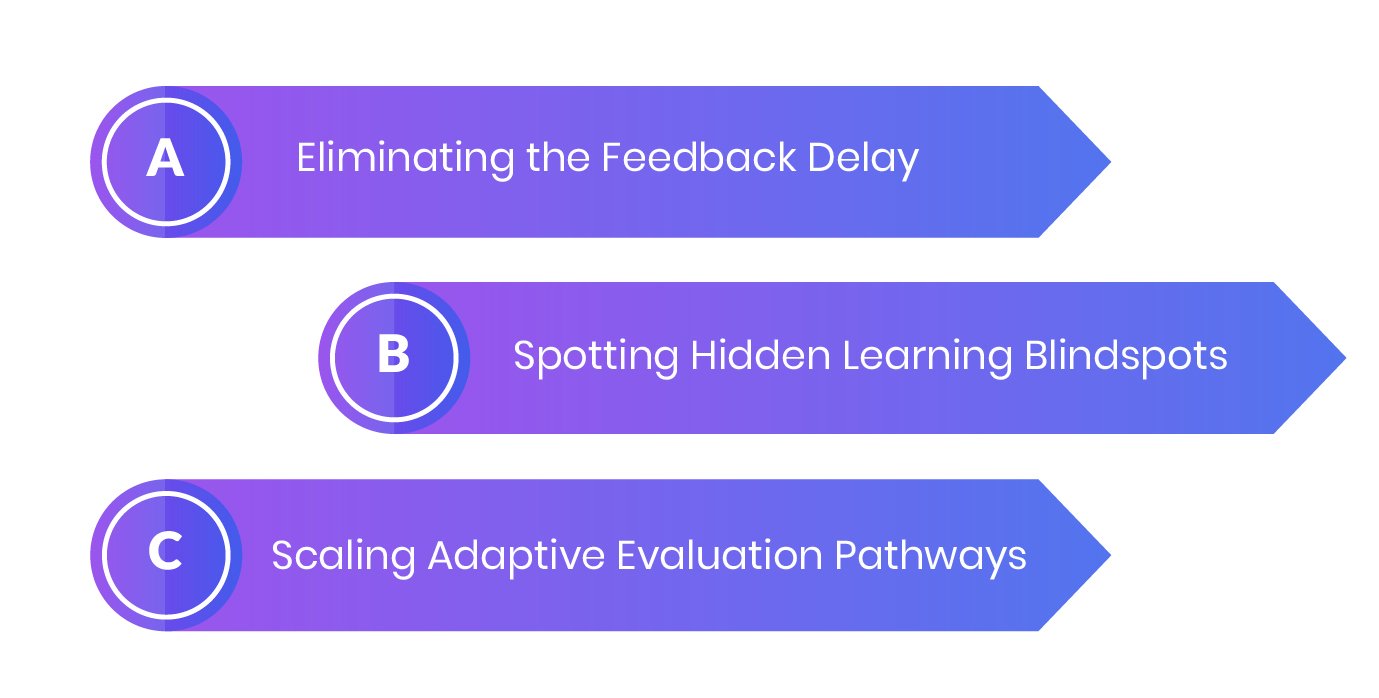
1. Eliminating the Feedback Delay

Imagine a student finding out after several weeks that the essay’s logic or mathematical proof doesn’t work. By that time, probably the student’s mind has wandered on to other things. AI models can understand natural language and recognise codes immediately. So, they can directly offer helpful suggestions when a student is facing difficulties.

According to the 2026 reports from Grand View Research and Vention Data, approximately 86% of educational institutions have structurally integrated generative AI into their workflows. Last year, the worldwide expenditure on IT structures in education was $82 billion, which demonstrates that smart infrastructure has moved beyond being a mere experimental phase to becoming a basic necessity.

2. Spotting Hidden Learning Blindspots

It is quite easy for human graders to overlook a subtle error that occurs frequently in 150 different essays. AI, then again, keeps track of patterns and checks performance trends across multiple assignments at the same time. For instance, it can notify an instructor that 30% of students in a certain group are having difficulty with “structural thesis formulation, “so the instructor can modify the lesson right away.

3. Scaling Adaptive Evaluation Pathways

Everyone thinks at their own speed; no two students are exactly alike. Adaptive algorithms change the level of difficulty of the question in real time based on how users are performing. This way, the students who are very good at the subject will not get bored, while the ones who are having difficulties will be guided through the basics gradually without being embarrassed.
The Power of the 1-on-1 AI Faculty Framework

In order to achieve optimal performance, many schools are ditching simple auto-graders and starting to use deep, conversational setups instead.

The main problem with typical software was its lack of human-like dialogue. This is exactly where powerful tools like the AI Faculty alter things completely. It’s a significant feature of One-on-One assessment is extremely useful for today’s generation. 

Rather than merely verifying if a student’s final result is correct or not, a One-on-One assessment tool puts each learner in a live, interactive Socratic conversation. It poses clarifying questions, encourages students to explain their thought processes, and adjusts its questioning based on their specific line of reasoning.

This profound analytical skill brings in two main benefits:

For the Student: It acts like a learning buddy, giving a no-pressure space where they can try out ideas, explain their thinking, and get coaching that is well-matched to their mental model right away.

For the Teachers: It offers a highly accurate record of a student’s genuine understanding at a conceptual level, revealing deeply ingrained errors which typical multiple-choice and short-answer testing methods completely overlook.

Gartner’s Strategic Tech Forecast reveals that more than 80% of companies and top universities worldwide are moving their learning systems towards AI-based tools to help with skill development and competency tracking at a faster pace. In addition, McKinsey’s analysis finds that tailored AI experiences lead to an increase in user engagement by around 30%, which helps in forming long-lasting learning environments.

How to Implement AI Tools for Student Assessment

The traditional classroom model is experiencing a critical logjam. On average, teachers dedicate 10 to 15 hours a week just to grading papers, which means they have very little time left for direct teaching activities. Besides, by the time students get their graded papers back, which is often weeks later, the learning momentum is usually lost.

Lucky for us, contemporary AI-based assessment tools are revolutionising the education industry. By integrating smart data analysis into the learning process, schools are now able to identify learning deficiencies in students before they result in poor performance.

According to recent statistics, students exposed to an AI assessment in education environment show far greater learning outcomes than those who learn in traditional settings. To understand these changes, first let’s discuss the role of AI in student assessment, the functioning of ai student assessment, and also, how to implement these workflows in your own educational environment.

Conclusion: Finding the Right Balance Between Automation and the Human Element

The implementation of AI assessment systems is not a way to remove teachers from the classroom by delegating everything to machines; rather, it is a way to get rid of the administrative work that is preventing teachers from focusing on students. Traditional tests are merely baseline checks, whereas transforming them into personalized learning dialogues will result in identifying learning issues early on, before they deteriorate into low grades. 

With the global trends towards widespread adoption of digital tools, only those institutions that incorporate conversational 1-on-1 assessments as part of their teaching methods to develop students’ problem-solving and critical thinking skills will stay ahead of the competition. Coupling quick, very efficient AI diagnostics with the kindness, encouragement, and experience of human teachers, we bring about an educational setting in which each student gets the support that they need for their success.

Looking to Learn AI Skills That Actually Matter?

AI Faculty is here to guide you.

FAQs

1. How can AI help in improving student performance in education?

One of the benefits of AI in school is that students can get feedback immediately; this way, they know how to fix their errors and keep strengthening their knowledge. In addition, they gain more confidence in themselves.

Grading systems built on AI technology implement the same set of criteria, thereby having fewer human differences or biases in scoring the students. Students highly appreciate receiving feedback immediately, as it is an important feature of formative assessment, and AI opens up the option for practically instant reactions to quizzes or drafts.

Besides, AI writing tools can be a helping hand to students in the initial stages, planning their thoughts, and editing the drafts. What’s more, rather than fixing the trivial or commonplace mistakes, the saving of time achieved through these tools can be redirected by teachers to concentrate on teaching and tracking students’ development.

Students utilising the AI Faculty One-on-One Assessment framework stand out for their deep diagnostic capabilities. Rather than just judging final responses like simple auto-graders, they involve pupils in an ongoing, interactive, and adaptive Socratic dialogue to capture students’ genuine conceptual understanding.

Students receiving assignments that fit their knowledge level perfectly is the result of their interaction with adaptive platforms. This is one way where the boredom factor due to the oversimplified assignments is minimized and the frustration of getting too complex tasks. Having pupils working in the zone of their proximal development most of the time is one of the key factors that determines the level of students’ engagement at the end of the day.

Models can unknowingly mirror the biases present in the historical training data if no measures are taken to control them. Currently, platforms “fight this problem” through intense algorithmic “auditing” only, “hiding” all student “demographic” data before evaluation, and also “providing detailed explanations of each score” that is generated.

Yes, advanced platforms these days utilise sophisticated multimodal processing. Instead of sticking to simple multiple-choice questions, they analyse and grade written essays, programming codes, and even complicated voice recordings. They assess by comparing the arrangement and reasoning against the rubric standards ahead rather than looking for exact text matches.