


Key Takeaways
- Transition to Active Ingestion: Actual retention of material occurs by way of dynamic, functional brainstorming with your material rather than mechanical rereading.
- Context-Locking is Essential: The best search engines employ closed-loop data spaces, which prevent algorithmic hallucinations and guarantee factual accuracy 100%.
- Granular Workflow Automation: For instance, automating the time-consuming administrative elements of education- like formatting flashcards or outlines, thereby conserving mental resources for true critical analysis.
- Adaptive Spaced Repetition to Our Forgetting Curve: Modern-day algorithms in education monitor your personal forgetting curve and cause certain fundamental ideas to re-enter your focus precisely when your brain starts to forget them.
We live in an era where academics are ever moving faster,r and the old sequential workflows cannot cope with the exploding volumes of work. If you are feeling overwhelmed by hundreds of pages of technical manuals, dense textbooks and mountains of lecture slides, rest assured, you are not alone. Six hours of sitting with a neon highlighter may seem tiring, but it is an inefficient method of allowing your brain to absorb the information. To scale your data absorption at a pace that matches the scale of your project, you need to become an active, system-oriented AI learner. According to Microsoft’s 2025 Work Trend Index, 75% of global knowledge workers now use AI in their daily workflows, while a 2025 HEPI study found that 92% of university students actively use generative AI for academic tasks. This rapid adoption signals a fundamental shift in how people learn, research, and retain information.
The urgency of this transition is backed by global data. A landmark industry study by McKinsey & Company revealed that enterprise and institutional AI adoption reached an all-time high of 88%, marking a massive shift toward algorithmic task-delegation. Working longer hours can be the last thing to do when you want to maximise retention. What’s really important is knowing what AI learning is and using a personalised AI study tool to help you automate information processing. Moving away from just text to interactive, data-driven setups, anyone – student or professional – can radically change the way their brain stores information. This detailed guide will dissect the workings of contemporary digital education, study personalised learning systems that adapt to your individual memory constraints, and provide you with a complete, stepwise plan to create your very own automated custom learning environment.
What is AI Learning? Unpacking Modern Digital Education
To thrive in a highly competitive academic environment, we must first address a foundational question: What is AI learning? At its core, it refers to an educational framework powered by machine learning, natural language processing (NLP), and neural networks designed to create a personalised, completely adaptive path for an individual user. Instead of a one-size-fits-all curriculum where every student reads the same page at the same time, digital learning algorithms analyse your real-time interaction with information, pinpoint your specific knowledge gaps, and dynamically adjust the complexity and delivery of the material. Research from McKinsey shows that AI-powered personalised learning systems can increase learning efficiency by 57% and improve student engagement by 30%, making adaptive education one of the fastest-growing areas in EdTech.
According to research from Gartner, generative AI has officially become the most frequently deployed solution in modern knowledge organisations. This fast expansion is compelling a complete redesign in how individuals approach cognitive skill-building. For an individual student, adopting AI learning means changing their relationship with data. Traditional study methods treat text as static information on a page. Advanced educational algorithms change this entirely by acting as a highly responsive, continuous feedback loop. If your system detects that you understand a concept quickly, it accelerates your path; if you struggle with a specific variable, formula, or historical timeline, it loops back with alternative analogies, structural breakdowns, and targeted practice problems until the concept is fully mastered.
The Core Advantages of Becoming an AI Learner
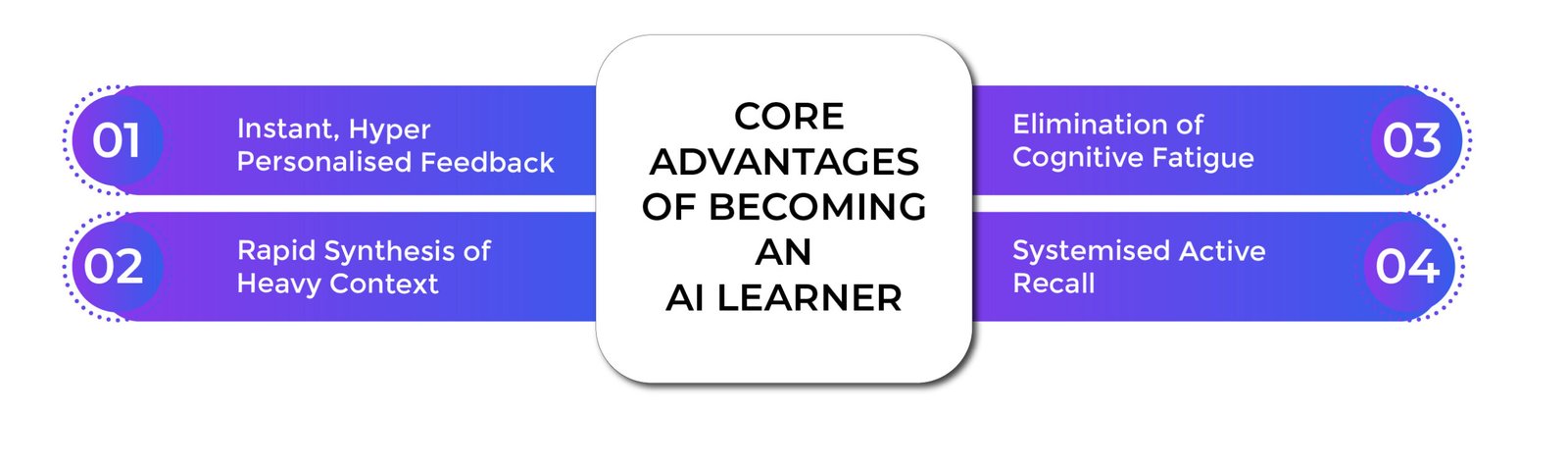
Going plus this behaviour change, you are not only doing a favour to yourself (time-wise) before a midterm, but you are changing your mind processes at the same time. Controlled studies made by Harvard Business School showed that people who used structured AI systems finished their analytical tasks 25.1% faste,r while at the very same time their overall quality was rated more than 40% higher than those who used the traditional methods. The main operational benefits that normal textbooks can never offer will be the first things you notice when you become a deliberate digital scholar:
- Instant, Hyper-Personalised Feedback: Instead of being informed about your logical errors only after the instructor has graded the exam and it is too late for you to make major changes in the way you work, this way, you get real-time validation of your reasoning and problem-solving steps.
- Rapid Synthesis of Heavy Context: Long, complicated 50-page PDFs and long multi-hour lecture videos can be transformed into neat outlines, conceptual blocks, and actionable summaries within seconds.
- Elimination of Cognitive Fatigue: By handing over to technology the work that is the bane of the student, e.g., organising notes or manually making flashcards, you can keep your mental energy for the actual doing and going really in-depth.
- Systemised Active Recall: Cutting-edge software systems keep a log of your memory retention intervals, and at the optimal times, when your brain is most likely to have forgotten a very complex concept, they automatically remind you to review it.
How to Build the Ultimate AI Study Tool Stack
To maximise your efficiency, you shouldn’t rely on a single browser window or a basic chatbot interface. The most successful digital scholars build a modular tech stack where different specialised engines handle distinct parts of the data collection and learning lifecycle.
Tool Category | Primary Function | Ideal Use Case | Industry Platform Example |
Context Storage & Synthesis | Context-aware document organization | Uploading thick textbooks and running queries directly against source documents | Google NotebookLM |
Research & Discovery | Citable semantic web search | Sourcing peer-reviewed academic papers without risking hallucinations | Perplexity AI (Academic Mode) |
Conceptual Mastery | Interactive tutoring & dialogue | Breaking down dense, abstract theories into simple, clear analogies | ChatGPT / Google Gemini |
Exact Computation | Algorithmic step-by-step solving | Verifying complex mathematical proofs, calculus, and structured scientific data | WolframAlpha |
Workspace Automation | Structural note-taking & logs | Building master knowledge bases and tracking personal study schedules | Notion AI |
Step-by-Step: How to Build Your Custom AI Study Tool
Pasting a simple sentence into an open prompt and asking an engine to “summarise this topic” will only yield generic, surface-level summaries. To achieve true academic depth and build a repeatable system, you must construct a structured context-and-prompt framework.
Here is the exact step-by-step guide to building an elite, personalised AI study tool ecosystem.
Step 1: Establish Your Context Boundaries
The outputs of your system are only as good as the context you feed it. Rather than allowing your platform to scan the open web- which exposes your workflow to irrelevant or unverified data- gather your official course materials. Upload your lecture slides, primary source PDFs, and syllabus documents into a context-locked workspace. This forces the model to draw its logic exclusively from your specific course materials.
Step 2: Inject the Elite Personal Tutor Persona
To prevent your program from giving a passive monologue, you need to set it to be an active, patient teacher. Copy and paste this precise engineering instruction into your workspace settings:
“Imagine you are a premium, patient and thoughtful university professor who mainly conducts Socratic dialogues. I will give you a topic from one of my uploaded files. You shouldn’t just give a summary or final answers. Instead, use a short analogy taken from daily life to explain the concept, then decompose the concept and ask me a question that tests my understanding before we proceed.”
Step 3: Run the Reverse Feynman Test
One should be able to explain a concept in simple terms if they really want to demonstrate that they understand it. Write your explanation of a complicated subject in simple English by placing it in the prompt window. Then tell the system: “Examine my explanation based on the documents we have. Point out to me any reasoning mistakes, factual errors, or omitted vital elements. Give a revised version showing what I overlooked.”
Step 4: Automate the Creation of Active Recall Flashcards
After you grasp the concept well, you can tell your platform to get the most valuable variables, definitions, and dates from the text. Ask the engine to produce structured front-and-back flashcard layouts. You can copy these straight into a flashcard app like Anki for automated follow-up.
Step 5: Simulate a High-Stakes Evaluation Loop
Never allow the official exam room to be the first time you put your recall to the test under stress. Tell your tool to create a five-question interactive quiz solely from your uploaded files, including three multiple-choice questions and two short-answer questions. Type your answers right into the chat window and ask for a detailed score breakdown, including the exact document citations where your reasoning was wrong.
FAQs
1. What is the difference between traditional study and AI learning?
In 2026, it will change the academies from strict, uniform models to highly individualized courses. Learning programs that process data in real-time can adapt to the individual biological rhythm of a student, thereby ensuring maximum memory. Besides, it can reduce the enormous grading task that teachers have to do
2. Can an AI study tool help me prepare for complex, standardized exams?
Absolutely not. When used effectively, it enhances our ability to connect. Teachers get back almost six weeks a year through automated administrative programs, allowing more time with students for one-on-one compassionate guidance, group sessions, and other emotionally substantiated support.
3. How can I make sure I am using an AI study tool ethically without cheating?
Leading platforms combine strong end-to-end encryption of cloud data with thorough workflows for data anonymization. Organizations should only work with certified EdTech providers who are in full compliance with international data security regulations like COPPA, FERPA, and GDPR.
4. What should I do if my tool hallucinates or gives me wrong information?
LSI (Latent Semantic Indexing) keywords refer to conceptually related words or groups of words, for example, adaptive assessment, learning analytics, intelligent tutoring, etc. These keywords assist modern AI search engines in understanding the context, determining thematic authority, and evaluating the final educational content value accurately.
5. How do I start learning AI?
Smart Content Creation: Teachers can make use of AI assistant technology for developing online instructional materials and digital accompaniment. Magic School AI, Eduaide.AI, and some other programs make the teaching process a lot more efficient. They help in lesson planning, creating tests, writing IEPs, and many other things that contribute to the modernization of education and simplification of teaching.
6. Is there any AI tool for studying?
AI enables students to benefit from personalized tutoring 24 hours a day, seven days a week, at their own pace. It offers customized study paths that focus on a student’s weak spots and also gives immediate feedback on the assignments. Besides, through real-time translation, AI makes learning accessible to everyone, and it can create various interactive formats – like flashcards made automatically – to meet different learning styles.
7. Is AI allowed for studying?
AI enables students to benefit from personalized tutoring 24 hours a day, seven days a week, at their own pace. It offers customized study paths that focus on a student’s weak spots and also gives immediate feedback on the assignments. Besides, through real-time translation, AI makes learning accessible to everyone, and it can create various interactive formats – like flashcards made automatically – to meet different learning styles.