


Key Takeaways for 2026 Aspirants
- Hyper-Personalization: Your study plan will match your strengths and weaknesses perfectly, and it will be different from everyone else.
- AI Faculty Integration: Get support from outstanding teachers anytime with virtual mentoring by AI faculty.
- Instant Resolution: Forget the days of waiting for a “doubt class”; you can get your questions answered in a second.
- Data-Driven Insights: The AI will notify you of your possible rank, and even before the exam, it will show you the areas you are weak at but are ignoring.
- Efficiency: You can cut down your study time by as much as 30% if you spend your time on only those things which you still haven’t grasped well.
Getting ready for India’s most difficult competitive exams, such as NEET, JEE, or UPSC, is Yes not just about hard work; it also takes a detailed data-oriented strategy. In 2026, the highest rankers who used AI learning platforms have made these platforms their primary secret weapon, Because of this replacing the traditional “one-size-fits-all” approach by implementing high-precision technology. So, if you are one of those who find complex Physics numericals or the extensive UPSC syllabus a problem, rest assured, these best learning apps provide a degree of efficiency that the conventional way of coaching is simply incapable of reaching.
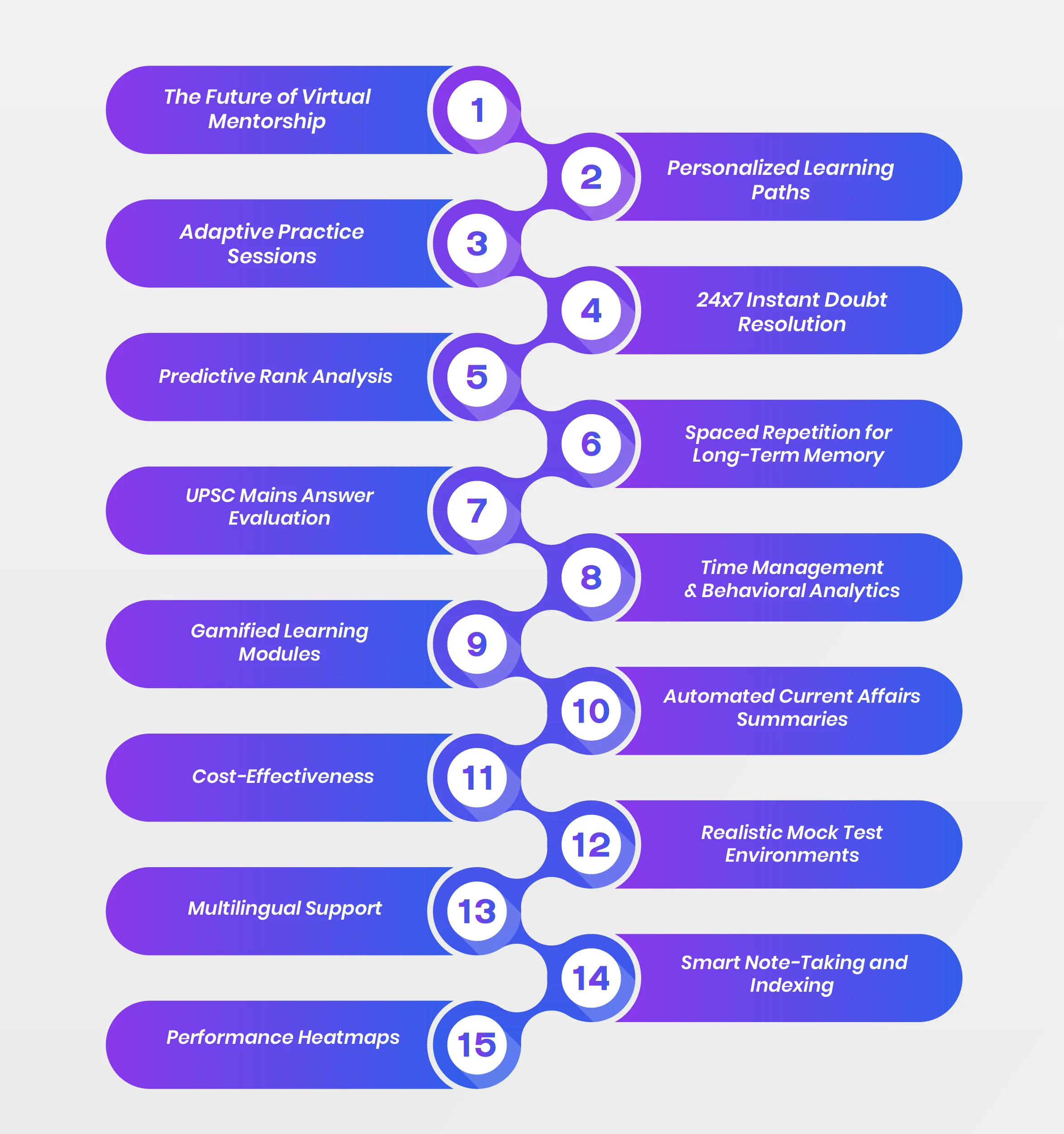
1. AI Faculty: The Future of Virtual Mentorship
One of the most significant highlights of current research is the rise of dedicated tools like AI Faculty. Since competitive exams are their primary focus, AI Faculty is like a personal tutor available 24×7 and has in-depth knowledge of the NEET, JEE, and UPSC syllabi at a very detailed level. This is not just a regular chatbot that delivers context-sensitive explanations, which assist students in progressing from mere memorization to thorough conceptual understanding.
2. Personalized Learning Paths
Traditional coaching arranges lessons that take place at fixed times. Unlike that, AI learning platforms use sophisticated computer programs to analyze your diagnostic tests and create a customized learning path for you. As a matter of example, if you are a JEE candidate who is very good at Algebra but weak in Calculus, the AI will give Calculus modules a priority.
3. Adaptive Practice Sessions
Unlike textbooks that remain unchanged, AI education tools come with a feature called “Adaptive Practice.” For instance, if you solve a NEET biology question correctly, you will be given a more difficult question next time. On the opposite side, if you fail, the AI will give you a less complex version to help you understand the main point better.
4. 24x7 Instant Doubt Resolution
Getting frustrated and stuck on a UPSC ethics case study at 2 AM is now a thing of the past. Using the latest AI learning apps, you just take a photo of the problem or type your query, and wonderful, detailed step-by-step explanations are at your fingertips right away.
5. Predictive Rank Analysis
Nowadays, online education platforms are equipped with “Score Predictors.” AI, by looking at your performance and that of thousands of other candidates, can predict your All India Rank (AIR). This would give you a clear idea of how much more effort is needed.
6. Spaced Repetition for Long-Term Memory
AI-powered flashcards use spaced repetition. They track when you are likely to forget a fact- like a UPSC history date or a JEE chemical formula – and prompt you to revise it at that exact moment.
7. UPSC Mains Answer Evaluation
In the case of UPSC, AI is also capable of grading the descriptive answers. Besides the structure (Intro-Body-Conclusion), it also checks the keyword density and relevance and gives the “mock score” as well as improvement suggestions within a few minutes.
8. Time Management & Behavioral Analytics
Some sites monitor the time you spend on a single MCQ. If you spend 5 minutes on what should be a 1-minute question, then the AI flags this “behavioral gap” and helps you enhance your speed for the real NEET or JEE exam.
9. Gamified Learning Modules
To address the issue of “exam burnout,” the best learning apps have adopted gamification
One of the ways they do it is by keeping student motivation high through earning points, unlocking “levels” in the UPSC syllabus, and competing on leaderboards.
10. Automated Current Affairs Summaries
For UPSC aspirants, summarizing daily editorials is really a waste of time.
AI tools not only scan the news sources but also provide a 60-word summary,y which is directly linked to the relevant GS Paper syllabus.
11. Cost-Effectiveness
Traditional premium coaching can be quite expensive, sometimes reaching even lakhs. Still, AI-integrated online education platforms not only provide the same or better level of personalization at a fraction of the cost but also help in making quality education available to rural students.
12. Realistic Mock Test Environments
AI simulates the exact interface and pressure of the NTA (for JEE/NEET) or UPSC CBTs. It can even use eye-tracking to ensure you maintain the discipline required for the final day.
13. Multilingual Support
Language is no longer a problem. AI is capable of translating complicated physics concepts of JEE or UPSC Polity notes into regional languages such as Hindi, Tamil, or Marathi on the spot without sacrificing technical correctness.
14. Smart Note-Taking and Indexing
AI education tools can automatically index your handwritten notes, which makes them searchable, and also summarize 50-page PDF documents into 2-page revision sheets.
15. Performance Heatmaps
Aspirants get to see a “Heatmap” of their syllabus. Red indicates dangerous topics where the student has low accuracy, while green is for the topics he is a master of, Because of this enabling a targeted revision.
How to Use AI Platforms to Master Your Syllabus
Integrating AI into your daily routine is simple if you follow this structured approach:
- Start with AI Faculty: Visit aifaculty.ai to set up your primary mentorship dashboard.
- Take a Diagnostic Test: Let the AI identify your “Base Level.”
- Follow the AI Roadmap: Instead of randomly picking chapters, study the “Recommended” topics the AI suggests daily.
- Practice via “Adaptive Mode”: Don’t just solve random MCQs; use the adaptive setting to ensure you are always being challenged.
- Review the “Error Log”: AI platforms automatically create a folder of every question you got wrong. Spend every Sunday reviewing only this “Error Log.”
Comparison: Traditional Coaching vs. AI Platforms
Feature | Traditional Coaching | AI Learning Platforms |
Pace | Fixed by the teacher | Set by the student |
Doubts | Scheduled sessions | Instant (24/7) |
Analysis | Manual/Subjective | Deep Data Analytics |
Revision | General for all | Targetted (Spaced Repetition) |
Cost | ₹50,000 – ₹2,00,000+ | ₹500 – ₹15,000 |
FAQs
1. Which AI tool is best for UPSC 2026 preparation?
AI Faculty and SuperKalam are at the forefront of UPSC preparations. They provide tailored services like evaluation of Mains answers and integration of current affairs. For general research, Perplexity AI is also very highly recommended.
2. Can AI platforms replace human teachers for NEET or JEE?
Absolutely not! AI is a ‘force multiplier’. Though AI learning platforms are quite helpful for practice and addressing doubts, a human mentor remains indispensable for providing advanced-level guidance and inspiration.
3. Are AI learning apps safe for student data?
Most reputable online education platforms in 2026 follow strict data protection laws. Always check if the app is ISO certified and read its privacy policy.
4. Which AI is best for NEET preparation?
Right now, AI Faculty and Embibe top the list of the most reliable platforms for NEET preparations. Besides offering massive question banks strictly based on the NCERT curriculum, they also showcase 3D visual explanations of tough concepts in Biology and Physics.
5. Which AI is best for UPSC students?
For UPSC preparation, AI Faculty and SuperKalam are two extremely good platforms that can be considered the best. Both these platforms provide a few very specific features like daily current affairs analysis, GS paper mapping, and AI-powered Mains answer feedback, which are quite in line with the evaluation standards of UPSC.
6. Which AI platform is best for medical students?
Apart from the NEET, medical students (MBBS) mostly depend on Osmosis (produced by Elsevier) and AI Faculty for clinical reasoning. These websites use artificial intelligence to produce adaptive flashcards in disciplines like Pathology and Pharmacology.
7. Which AI is best for doctors to use?
Physicians mostly rely on clinical decision support tools such as UpToDate (which has an AI search built in) and Glass Health. Besides, they serve quite well in differential diagnosis and monitoring of the recent medical journals, which have been peer-reviewed.